AI is eating everything. How is China’s intelligent war actually shaping up? What are the internet giants doing—and who wins?
I spent the last few days at AI meetups—ByteDance, Alibaba, local salons, founder nights. The pattern is hard to miss: the giants are fighting hand-to-hand; smaller shops are picking sides; traffic hustlers are selling anxiety; many startups are waiting to die.
Columbia professor Bruce C. N. Greenwald—once called by The New York Times a “guru to the gurus” of Wall Street—turned Buffett-style investing into a usable system. One of his books is Value Investing: From Graham to Buffett and Beyond. The competitive-advantage decision tree below comes from that lineage[1].
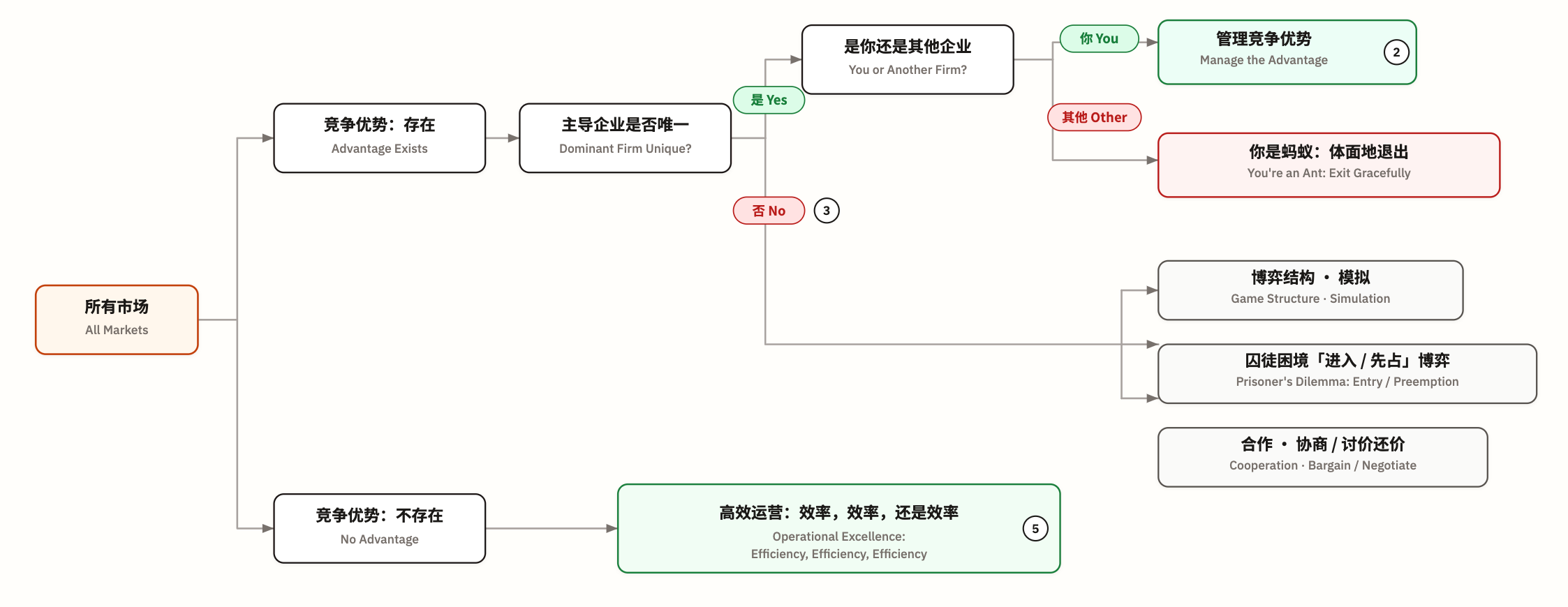
His first question is blunt: does the market have a competitive advantage—Buffett’s moat, a barrier that keeps newcomers out and lets incumbents earn durable returns? Buffett rode that idea all the way to the top of the Forbes list in 2008.
Four kinds of barriers
1. Supply-side advantage (true cost advantage)
You can produce cheaper than rivals. Sometimes that is exclusive access to ore or easy oil. More often it is proprietary technology—patents, process know-how, or both.
Saudi Aramco can lift a barrel for roughly three dollars; U.S. shale might sit near forty; oil has traded around eighty this year. Cost three, sell eighty—nature writing the dividend check. ASML is the technology version: the most advanced chips still need its lithography machines.
2. Demand-side advantage (customer captivity)
Some firms own demand rivals cannot easily reach. That is not “branding” in the soft sense—rivals can brand too. Captivity comes from habit, switching costs, and the pain of searching for substitutes.
WeChat is the textbook case in China: drop it and you struggle to reach friends and clients. Phone numbers and Apple’s hardware–software stack work the same way. Without a powerful reason, people do not leave.
3. Economies of scale
When fixed costs dominate, unit cost falls with volume. Even without better tech, the large incumbent can undercut smaller rivals.
Software is the extreme: Windows and Office are built once and sold everywhere; the marginal cost of another copy is near zero. Many U.S. SaaS products are one site serving everyone—same logic, and part of why SaaS multiples ran so high.
Coca-Cola shows scale in the physical world. From its 2025 disclosures, daily servings are on the order of 2.2 billion; divide a roughly $5 billion annual ad budget across that volume and each serving carries a fraction of a cent of advertising. Beating that cost structure is brutal.
4. Government protection or information edges
State banks and oil majors in China sit in this bucket.
The durable combination is usually captivity plus scale. Plenty of Coke drinkers will never touch Pepsi. Founded in 1886, Coke has survived world wars and every tech cycle from horses to AI—and Buffett’s stake is not a mystery.
Do foundation models have a moat?
Building a frontier model may buy a temporary technical edge. Time erodes it. Many Chinese models are already closing in on global leaders this year. “Nobody else can train a model” is not a reliable barrier.
Almost every lab still runs into NVIDIA. Since around 2006 it has spent two decades building CUDA and the training stack; once you are in, switching is painful—captivity. When AI demand exploded, chip volume amortized R&D—scale. That locking-plus-scale story is why NVIDIA sits at the top of the market-cap charts.
Inside China the fiercest fight is among model builders. A China Data Research Center ranking for 2026 lists on the order of 68 mainstream model vendors: internet giants like ByteDance, Alibaba, and Tencent, plus natives such as DeepSeek, Zhipu, Moonshot, and MiniMax.
Greenwald’s rule still applies: no barrier, then only operations—relentless efficiency in every step of the business.
The new BAT three-way war
China’s biggest internet trio is now ByteDance, Alibaba, and Tencent—and they spend the most on AI.
For a decade the fights never stopped: short video, WeChat Pay vs Alipay, food delivery, public cloud, local services, office software, e-commerce, livestream commerce.
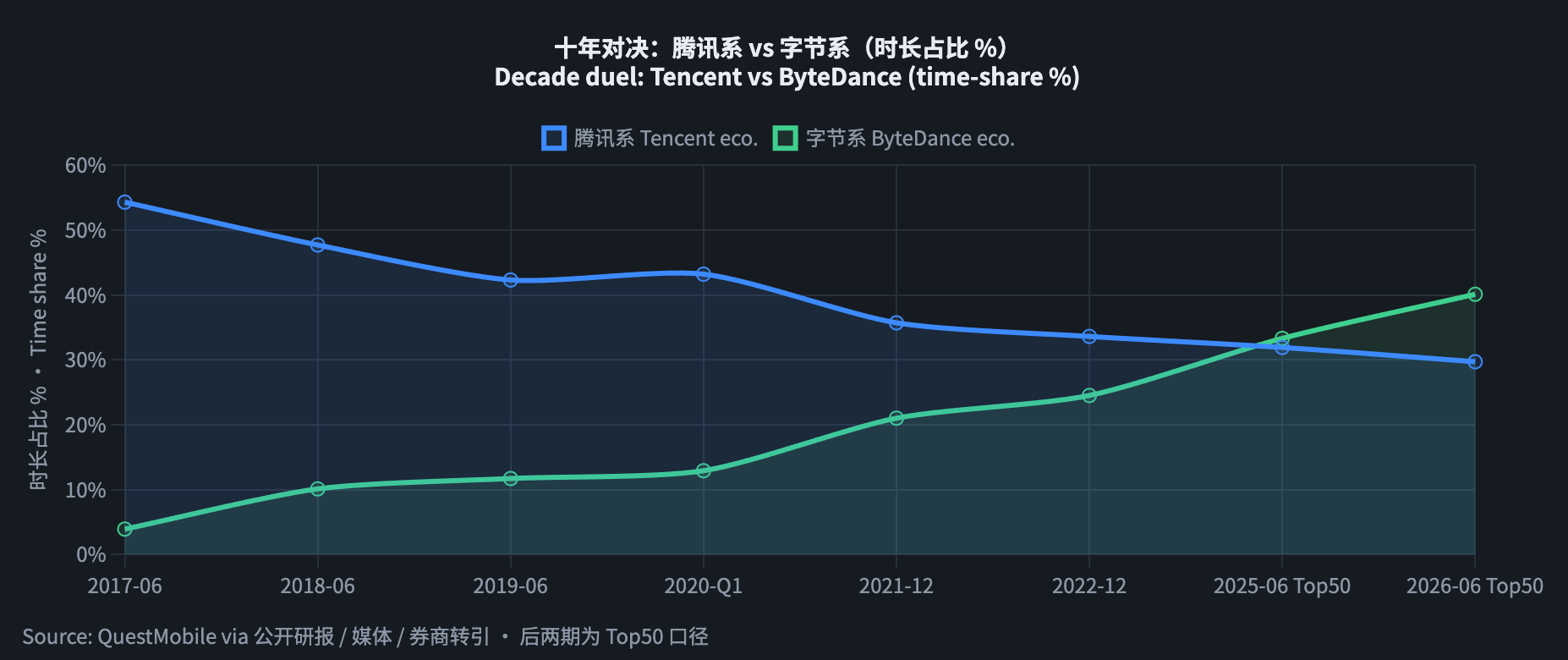
The clearest structural moat belongs to Tencent: WeChat locks users in, so traffic anxiety is lower. Still, it cannot erase the other two. ByteDance’s short-video offensive overtook Tencent on time-spent and made Tencent feel the heat.
Since 2017 ByteDance has displaced Baidu in the “BAT” shorthand. By 2025, ByteDance apps led Tencent on user time-spent.
By 2023, ByteDance revenue had already passed both Tencent and Alibaba.
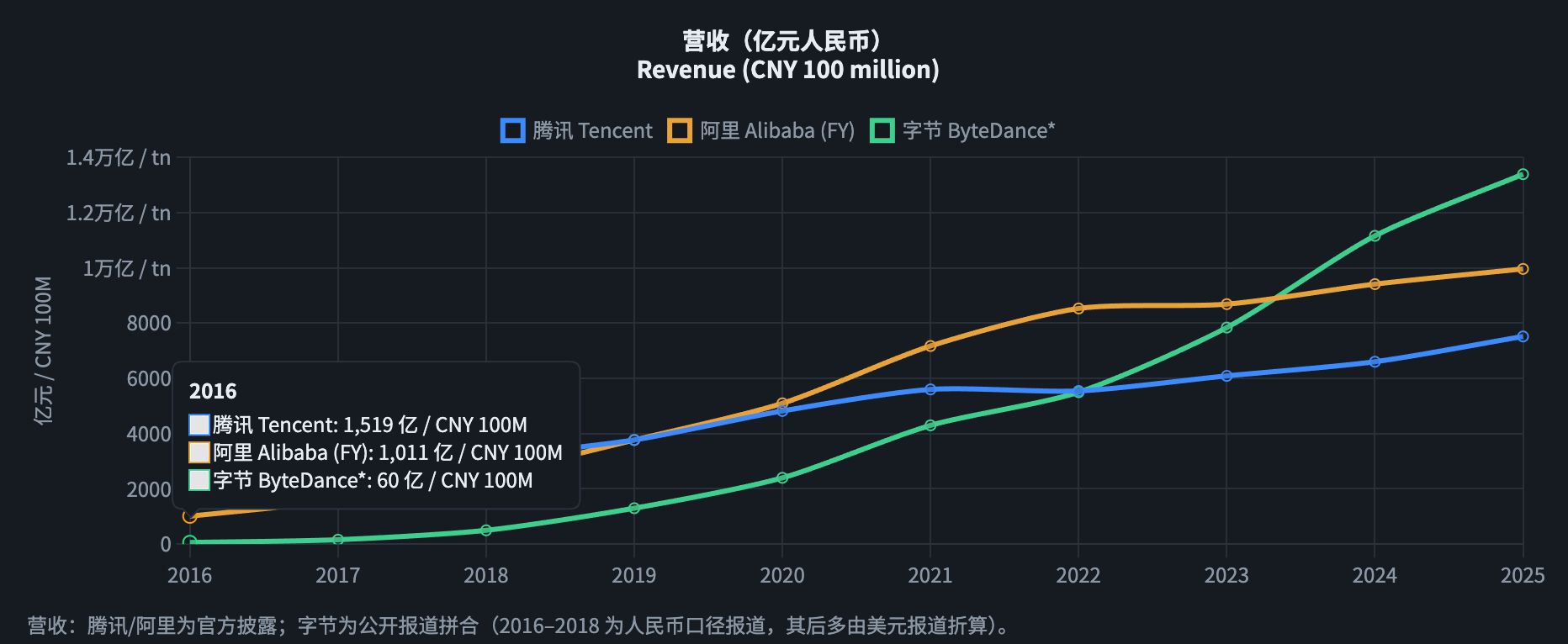
So ByteDance has already won?
Not that simple. Look at phone installs: among the top ten apps, Alibaba and Tencent each hold about three seats; ByteDance mainly shows up as Douyin/TikTok. On breadth of daily life, Tencent and Alibaba still run deeper.
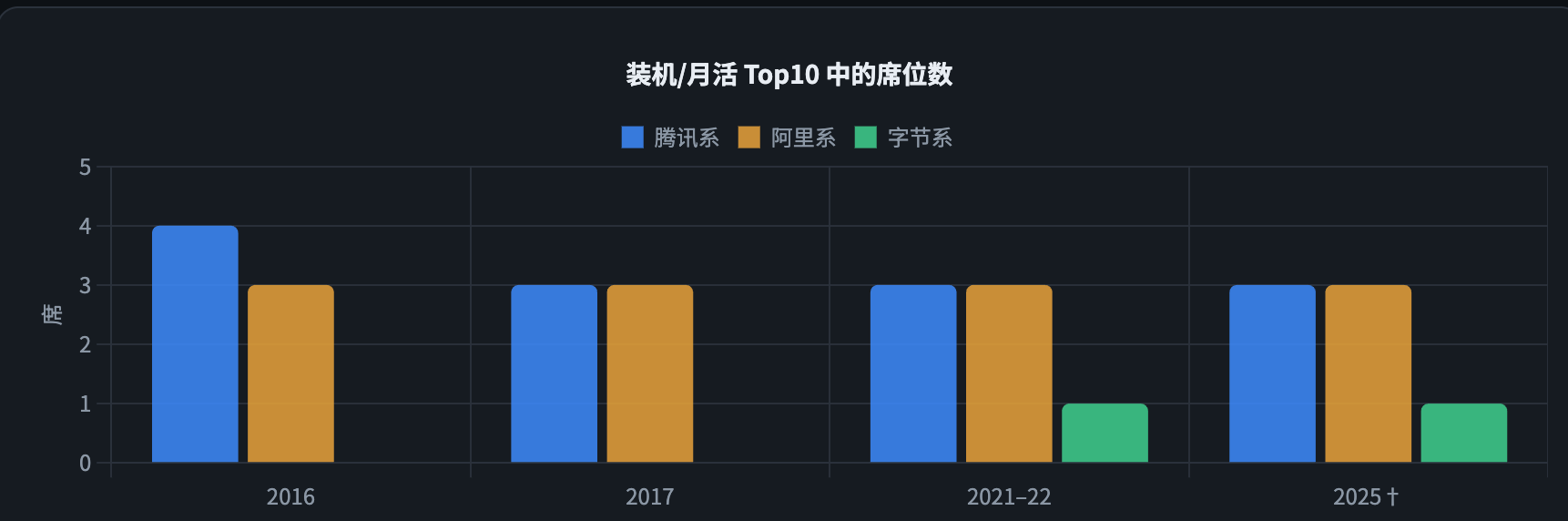
Tencent is also pushing Channels (视频号) as a commercial counterpunch in short video.
The stalemate looks like this: ByteDance leads for now—time-spent king, sharp algorithms, aggressive growth, but a narrower empire. Tencent holds WeChat, the deepest moat, plus a vast investment web. Alibaba owns commerce—e-commerce, payments, local services. Three choke points: attention, relationships, transactions.
Late 2022 they were settling into operational trench warfare. Then ChatGPT lit the field again.
ByteDance: all-in—and paying for inference
ByteDance entered hard in 2023, stood up a full AI stack in about a year, made Doubao the largest consumer AI product by users, and pushed Volcano Engine to the top on token burn.
If anyone is second on AI spend, nobody claims first: roughly RMB 150 billion in 2025, about 160 billion planned for 2026, plus the priciest Spring Festival Gala partnership in 2026.
Yet Doubao’s daily revenue was still reported around the million-yuan level. That is fighting an AI war with internet muscle memory. Old internet products can approach zero marginal cost per user; every model call burns real compute. Even ByteDance flinched—Doubao Pro started charging in June 2026.
On July 30, 2026, Feishu/Lark was folded under Doubao. Xie Xin, who had reported to CEO Liang Rubo, now reports to Doubao lead Zhao Qi. The spark looks like a market report: in June 2026, Tencent’s WorkBuddy hit about 20.97 million monthly visits and ranked first among office AI products. Internally it has been described as a “super project,” with Pony Ma personally involved.
Next-gen office AI may redefine the category. Feishu’s strength is knowledge bases and human collaboration. The next wave may reduce human chatter and deepen human–Agent work. Folding Feishu into Doubao is ByteDance answering Tencent on that battlefield.
Tencent: restrained on LLMs, aggressive on WorkBuddy
In 2025 Tencent hired former OpenAI researcher Yao Shunyu to lead models. Yuanbao and Hunyuan had underwhelmed. Relative to ByteDance’s blitz, Tencent has been more selective on general models—and heavier on the office Agent bet.
Alibaba: full-stack ambition, Qwen Work as a merge
Alibaba earns less profit than the other two but wants the whole stack—chips, models, cloud, apps—with about RMB 480 billion earmarked over three years. In 2025, daily user-acquisition spend on some AI apps hit the tens of millions of yuan, yet consumer hits still lag Tencent and ByteDance. Infrastructure is underrated: in-house AI chips are selling externally, and open-source Qwen has real pull.
With WorkBuddy and Doubao×Feishu charging into enterprise office, Alibaba moved too. New DingTalk CEO Chen Yusen merged QoderWork, Wukong, and MuleRun into Qwen Work (千问办公) around July 27—an enterprise AI office push built from three internal Agents.
Office software: a stable oligopoly—until Agents?
I use Feishu most; I have tried DingTalk and WeCom.
Reported 2025-era figures (QuestMobile and media round-ups) look like this:
| Metric | DingTalk | WeCom | Feishu |
|---|---|---|---|
| Monthly active users | ~200M | ~100M | ~30M |
| Market share | ~32.7% | ~23.4% | ~18.9% |
DingTalk’s MAU is about 7× Feishu’s, yet share is not 7×. WeCom’s MAU is more than 3× Feishu’s, yet shares are closer. Feishu users pay; sticky knowledge bases deepen captivity. Many firms use DingTalk as a punch-clock. WeCom’s edge is WeChat connectivity—customer acquisition and reach.
The office layer looks like a temporary three-way truce. Can AI overturn it?
Combined share near 75% with relatively stable ranks suggests barriers on the base layer. Profit is another story: Feishu’s 2025 revenue was reported above RMB 3 billion and still loss-making. Horizontal office SaaS is expensive to run.
Barriers without a single dominant firm → Greenwald’s game-theory zone. Three common games:
- Prisoner’s dilemma — distrust, race to the bottom on price.
- Entry / preemption — someone seizes a new position; incumbents match or tolerate (classic in heavy capacity races).
- Tacit cooperation — no press release, but everyone refrains from suicidal price wars.
Three unprofitable giants look like a prisoner’s dilemma. Two suspects both stay silent and may walk with light charges; separate them and each has a reason to confess first. The usual destination is a Nash equilibrium where cooperation collapses. Firms play the same script.
So: free features, feature bloat, channel subsidies—and nobody makes money. AI does not dissolve that game; it raises the burn. Products start to feel like junkyards—everything included, no taste. Jobs’s line about Microsoft still cuts: have no taste.
Short-video success theology
SMEs suffer most. When lions fight over a carcass, the fox that tries to take a share is usually killed or absorbed—not invited to co-build the ecosystem.
If standing upright does not pay, people go sideways into traffic. Feeds fill with AI anxiety; the funnel often ends in courses that mint more creators shouting, in awkward Mandarin, that you will be obsolete if you skip AI.
Creators without traction then slide toward Chen Changwen–style high-volume matrix dogma—his public methods push multi-account posting, dozens or even a hundred clips a day, and “don’t worry about quality, just ship.” Failure gets rebranded as “you still don’t post hard enough,” and the feed fills with sludge.
While giants trade blows, small firms bleed for scraps, and anxiety accounts spray noise, someone else says: stay restrained; do the work in front of you; I will not fight you for sesame seeds—I only want one scoop of watermelon.
Liang Wenfeng’s restraint
That someone is Liang Wenfeng. He argues AI may eventually claim on the order of 10% of global GDP; no single firm can own it, and refusal to share is a death sentence. In a modern economy, value comes less from bigger and heavier things than from smarter ones.
DeepSeek never obsessed over a super app; users still refuse to leave. While BAT fights over every tray on the table, DeepSeek hunts AGI. Picture a rural banquet when a plate of fried shrimp arrives: kids swarm it; one child waits, smiling, then takes the piece that was always going to be theirs.
Liang sketches five stages toward AGI:
- Clear problem + full context → solid answers.
- Chain-of-thought reasoning.
- Tool-using Agents—roughly where we are.
- Continual learning.
- Singularity: self-improvement.
His near-term bet is continual learning—not another office AI, not a C-end DAU trophy. Of the ten thousand waters, take only one scoop. That is restraint.
Other Chinese native labs are rising too. In March, Zhipu’s market value briefly cleared HK$1.3 trillion, trailing only Tencent and Alibaba in the internet/AI cohort. After GLM-5.2 launched, Elon Musk answered a question on X about when Chinese models might reach Anthropic’s Fable level—he pointed to roughly Q1 2027, and the prompt mentioned GLM-5.2 closing the gap. That was a timeline debate, not a product endorsement. July’s Kimi K3, with about 2.8 trillion total parameters, has beaten top U.S. models on some tasks. China is on the scaling road; the illusion that “models are an unbreakable moat” is cracking.
Momentum is real; so is the hangover: dozens of vendors, talent scatter, pointless rivalry, and an eventual shakeout. Who becomes dust? Who can dent the three giants? Can anyone dent NVIDIA’s myth? Is there still a seat for ordinary builders—and how do you take it?
In the Yijing tradition, ji (几) is the subtle beginning of motion—the first flicker of fortune before it shows. See the ji, and act.
Follow along. I will keep writing—so you can see the silicon ji.
Notes
[1] Competition Demystified