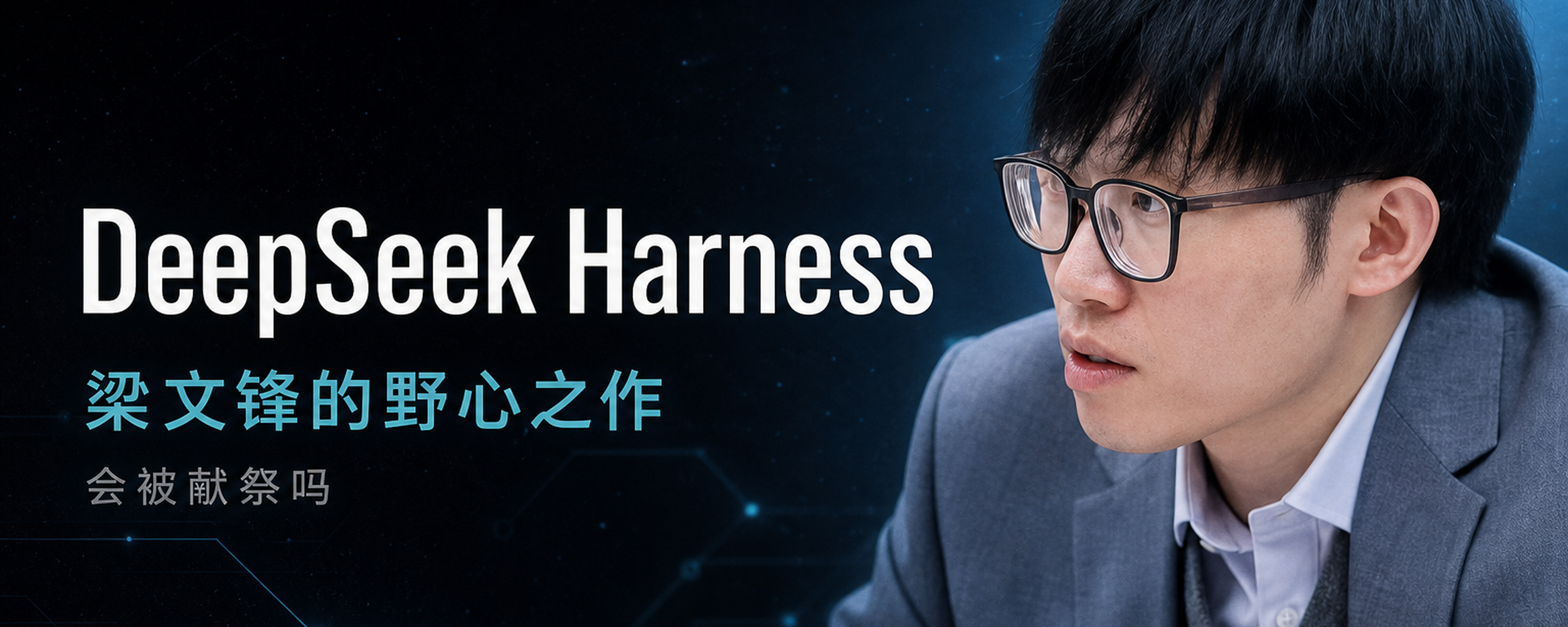
A few days ago, DeepSeek dropped an Agent Harness out of nowhere. It is Liang Wenfeng’s most ambitious move yet. The tech looks years ahead of the market. That is exactly why it might get sacrificed.
You open a chat box, type a line, and the model comes back fast and steady. You think you are using artificial intelligence. More precisely, you are using two things welded together: a model, and an environment that lets the model actually work. That environment is the harness. The model is the brain. The harness is the body. Model + Harness = Agent. This time, Liang finally gave the model a body—and this body is not OpenAI’s Codex, not Anthropic’s Claude Code, not anyone else’s agent. It can evolve itself.
Taking the road nobody else wants
Back in May, word leaked that DeepSeek was going to build its own agent harness. The pile-on started immediately. Why now? Why not just use what already exists? Pi, Codex, OpenCode—plenty of open-source harnesses are mature. Just pick one up and go.
DeepSeek said nothing. Then on August 13, DeepSeek Harness shipped v0.1. No applause. Developers roasted it as a paper-writers’ fantasy: people who publish, not people who ship.
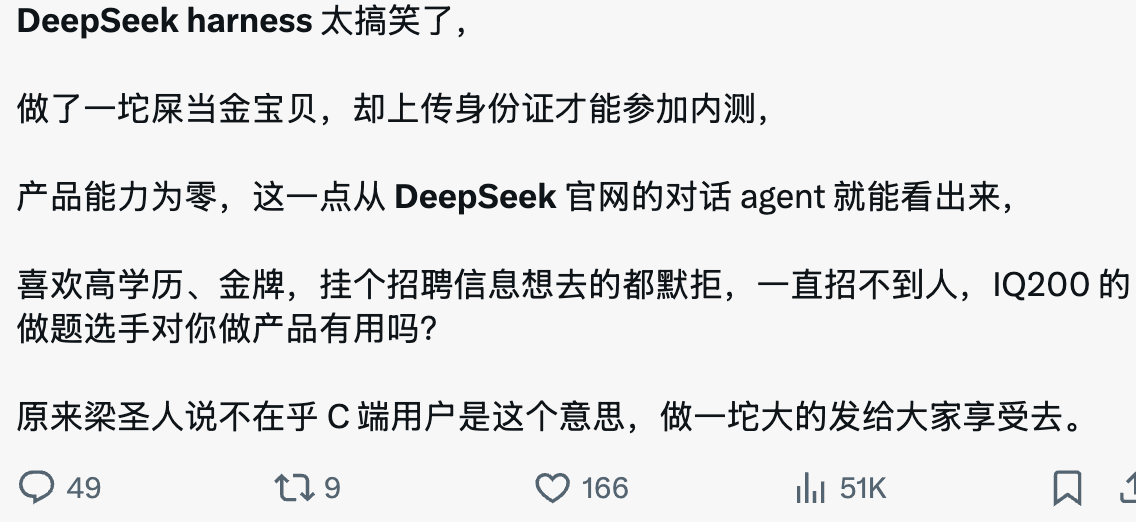
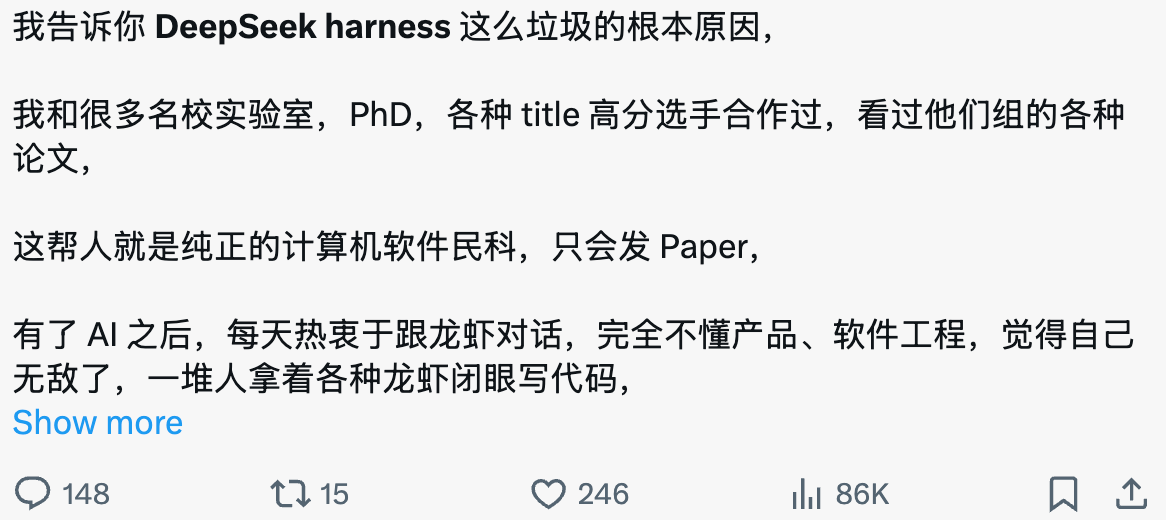


Is that actually the story?
DeepSeek could have done the safe thing. ByteDance’s Trae copies Cursor. Alibaba’s Qoder copies Claude Code. Tencent’s Workbuddy copies Codex. Ship something polite, almost-good, and hard to dunk on.
Liang does not work that way. If you only copy, you never pass anyone. If you do not invent, you do not get a shot. If you do not take the risk, you do not take the world.
DeepSeek Harness is Liang’s work in the usual sense: not designed for KPIs, not designed to please users, designed for the agents that are not here yet.
The design philosophy
Codex and Claude Code are harnesses too. They stitch tools, skills, sessions, sandboxes, storage, loops, scheduling, and sub-agents into one product. What a normal user can still touch is Skill, MCP, and a few hook points. Everything else is welded shut.
DeepSeek Harness is different. The slogan is four words: everything is a plugin. The model, the tools, the skills, even the UI—all plugins. Under the plugins sits a kernel called Cordis. It does three things: load plugins, unload plugins, and manage their dependencies. It does not carry any agent capability of its own.
The writer Kazike put it this way: people who like it call it the future; people who don’t call it rough. That may be why so many people are angry. They wanted something that works out of the box—the jolt of Jobs walking out with an iPhone. Liang did not ship an iPhone. He shipped the thing Apple had to start with. The iPhone can be beautiful and iOS can be smooth; both still stand on UNIX. UNIX is the ancestor of operating systems, and its philosophy is one line: everything is a file. Every feature, at the end of the day, is reading and writing files. Even the complicated jobs are a few small tools snapped together. DeepSeek Harness can be read as an operating system for agents, and its philosophy is also one line: everything is a plugin. The kernel loads, unloads, and tracks dependencies. What you do with that is your problem.
The other plugin system people still admire is VS Code. It was the default editor in the pre-AI era. Even in the AI era, Cursor, Trae, and a pile of AI coding tools are forks of it. Those tools are now getting eaten by AI-native ones—Codex, Claude Code. Cursor, the first real AI coding product, is slowly leaving VS Code behind and becoming native too. So why did VS Code lose its life, even though it is also a plugin system? Because VS Code decides what a plugin may do and may not do. Plugins do not share a real data structure. They still have to go through VS Code’s privileged core process. It is like sending money on WeChat: the transfer actually runs through Tencent and the banks. You cannot tap two phones and move the money yourself. Without those privileged institutions, the cash never lands—unless you use a blockchain. DeepSeek Harness has no centralized privileged process. That, I think, is the real difference between VS Code’s plugin system and DeepSeek’s.
Software architecture is a worldview. Other agent harnesses let the vendor decide who is the core, and what everyone else is allowed to do. It is the American-values move: I define the ideology; accept it and you are a friend, reject it and you are an enemy. DeepSeek Harness flips the table. Everything is a plugin means nobody gets a privilege. You define yourself. There is no official ideology—only a shared aim of AGI. Like Xu Fu in the film Dragon Restaurant: when everyone else is eating people, he is feeding them.
After the release, I tried a small product on top of it. I turned Codex, Claude Code, and Pi into plugins and dropped them into DeepSeek Harness. The repo is here: https://github.com/loopwithai/LoopWithAI
You can feel how much it can hold. It made me think of Bruce Lee: Be water, my friend.
Who gets to define the next harness?
Here is the question. Are Codex and Claude Code the best agent harnesses we will ever get? Who decides what the best shape even is?
Nobody knows. If nobody knows, do not define it. Let it grow.
Every great thing grew. Earth gave you an environment. It did not define “human.” Give it enough time and you get a brain like ours. Great companies are not the ones that followed a rulebook. They grew out of a moment: loose policy, a live market, the right founder. UNIX said one thing—everything is a file—and let pipes snap tools together. That tiny philosophy grew Linux, macOS, Android, and then the internet.
Systems that can grow and evolve share one trait: the parts can change without the whole collapsing. DeepSeek Harness gives you a plugin environment. Each plugin can evolve on its own. The rest does not fall over. Same as genes: one gene changes and the whole body does not fail at once. The arm gets a little longer; the heart is still the heart. That is how life tries things—wings, then eyes. Cities work the same way. The street downstairs was a repair shop ten years ago, a milk-tea shop five years ago, a parcel station last year. Every shop changed. The street did not die. It got more alive. If a city were a machine, and swapping one gear meant shutting the whole place down, it would never grow up.
That is what DeepSeek Harness is trying to be: a harness that can grow itself. Plugins can combine any way they want, evolve any way they want. The wild part is a harness already running in production, updating itself with no downtime. Today, a release still means stop the service, start it again. If you want users to keep going while you cut over, you reach for container orchestration: keep a replica up while one instance dies, bring the new version online, drain the old one, then spin another replica for slack. The whole dance takes a few minutes. Every restart rebuilds the runtime—import the modules, compile them into a fixed program, reload config, reopen the database. That is a process-level or service-level restart, and it throws away runtime state. DeepSeek Harness can keep serving users while it rewrites its own components. Zero restart. Zero state loss. That is a different software paradigm, and it points at what an agent harness should look like next.
Liang Wenfeng’s ambition
In an internal investor conversation, Liang said AI is big enough that it may end up as ten percent of human GDP. No single company can own that market. You have to share it, or you do not survive. In a modern economy, value does not come from building bigger or heavier things. It comes from building smarter ones.
Liang also said DeepSeek never set out to make a super-app. Users just would not leave. ByteDance, Tencent, and Alibaba are fighting over the food. DeepSeek is trying to reach AGI, and the users show up anyway. It reminds me of a short video from a village banquet. A plate of fried shrimp hits the table. The other kids dive in. One kid just smiles, waits until the grabbing stops, and takes the piece that was always his.
Liang’s path to AGI has five stages:
- Stage one: Describe a problem clearly, give full context and instructions, and the model answers well.
- Stage two: Chain of thought. The model learns to think step by step. This is the reasoning model.
- Stage three: Harness plus model becomes an agent. This is where we are.
- Stage four: The AI can keep learning.
- Stage five: The singularity. The AI iterates on itself.
What Liang is trying to do now is continual learning. DeepSeek Harness looks like the foundation for the singularity—not the next coding agent, not a grab for users. He does not care about those numbers. He only needs to keep walking the intelligence path until AGI shows up.
The sacrifice
One step ahead, you are a pioneer. Two steps ahead, you might be a martyr. Whether the tech is “right” is often not the point. Whether the timing is right is.
Will DeepSeek become the martyr?
UNIX is the starting point of modern operating systems. Almost nobody runs UNIX itself anymore. Bell Labs, the lab that made it, is gone from that story too. What we see are the descendants: Linux distros on servers, iOS and Android on phones, macOS and a growing set of Chinese desktop systems. All of them come from UNIX. None of them is the UNIX that started it.
In 1882, Edison built the first commercial power station in Manhattan—Pearl Street. The current was DC. DC is simple. The voltage stays put. It is safe. The bulbs light. The telegraph runs. Edison made money, got famous, and built a pile of stations.
DC had one fatal problem: it does not travel.
You cannot change DC voltage. Wires have resistance. The farther the current runs, the more it dies. A kilometer out, the lamp is dim. Two kilometers out, it is dead. So Edison had to plant a station every mile. Light a city and you need dozens of them. Leave the city and you can forget about electricity.
Tesla had something else: AC. AC voltage can move. Step it up with a transformer and it can run hundreds of kilometers. One station can feed a city. You do not build one every mile. That is the problem DC could not solve.
Tesla started out working for Edison. Edison told him there was fifty thousand dollars in it if he pulled it off, then paid him nothing. Tesla left, took the AC patents to Westinghouse, and Westinghouse started building AC plants.
Edison panicked. To poison the idea, he publicly killed horses, dogs, and an elephant with AC. He pushed to have death-row inmates executed with it. The point was one thing: make the public afraid of AC.
In 1895, Westinghouse sent AC more than twenty miles to another city. DC could not do that. AC could. AC became the default. DC lost.
Tesla sold the patents to Westinghouse cheap. Later, when Westinghouse was short on cash, Tesla tore up the royalty contract so the company could live. He never collected those royalties.
AC lit the world. Tesla spent his last years in a New York hotel, too broke to cover the room, walking to the park to feed pigeons. In 1943 he died in a hotel room. A pigeon was the only company he had.
The film Prometheus opens with a pale alien standing by a waterfall on Earth. He drinks a black liquid. His body comes apart and falls into the water. His DNA spreads. Life takes root. Hundreds of millions of years later, humans show up.
The maker dies. What he made lives.
Will DeepSeek be that maker?