Why is learning math so miserable? How do the actual mathematicians see it? I just finished David Bessis’s Mathematica: A Secret World of Intuition and Curiosity.[1] The book’s claim is blunt. We have been tortured by abstract definitions and formal logic. The real players—Descartes, Grothendieck, Thurston—do not think in textbook proofs. They think with intuition. That craft circulates among the best mathematicians and almost never survives being written down. Bessis calls it “secret math.”
Bessis is a mathematician by training. He did his PhD in geometric group theory at Université Paris Cité, then worked at Yale, the CNRS, and the École Normale Supérieure, across algebra, geometry, and topology. Around 2008 he left academia and started an AI company.
Why intuition instead of logic? Keep going.
Can a straight line hit a circle at three points?
You already know the answer. In your head you draw a circle and a line, and you try to make them meet three times. They never do. That picture in the mind is what Bessis calls a mental image. It is intuition doing the work.
Now suppose someone says they cannot see it. What then? Mathematicians, wanting to be precise, write a theorem: in the plane, a line and a circle meet in at most two points. Then they attach a geometric proof, and an algebraic one: a quadratic equation has at most two roots.
Learn it that way and your head starts to hurt. That is also what class calls the correct method. The thinking we are actually good at—the thinking that feels like play—gets treated as a mistake, so we use it less and less. The people who get good at math never really learned from the textbook. They spent the whole time quietly stacking these obvious mental images.
The Gauss story, taught the wrong way
Everyone heard the Gauss story in school. The teacher told the class to add the integers from 1 to 100, hoping for a few minutes of quiet. One kid finished in seconds.
When teachers retell it, they usually say there is a trick. Line the numbers up like this:
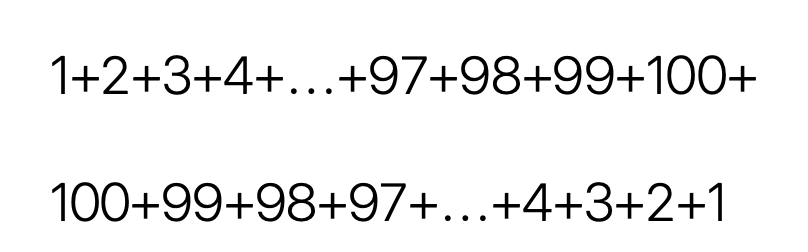
Each pair adds to 101. There are 100 pairs, so 100 × 101 = 10,100. Half of that is 5,050.
Fast, yes. A cute trick, also yes. What the teacher is actually planting is a bad idea: math means memorizing tricks.
Try it as intuition and you do not memorize anything. You turn the sum into a picture. Each number is a column of squares: one in the first column, two in the second, a hundred in the last.
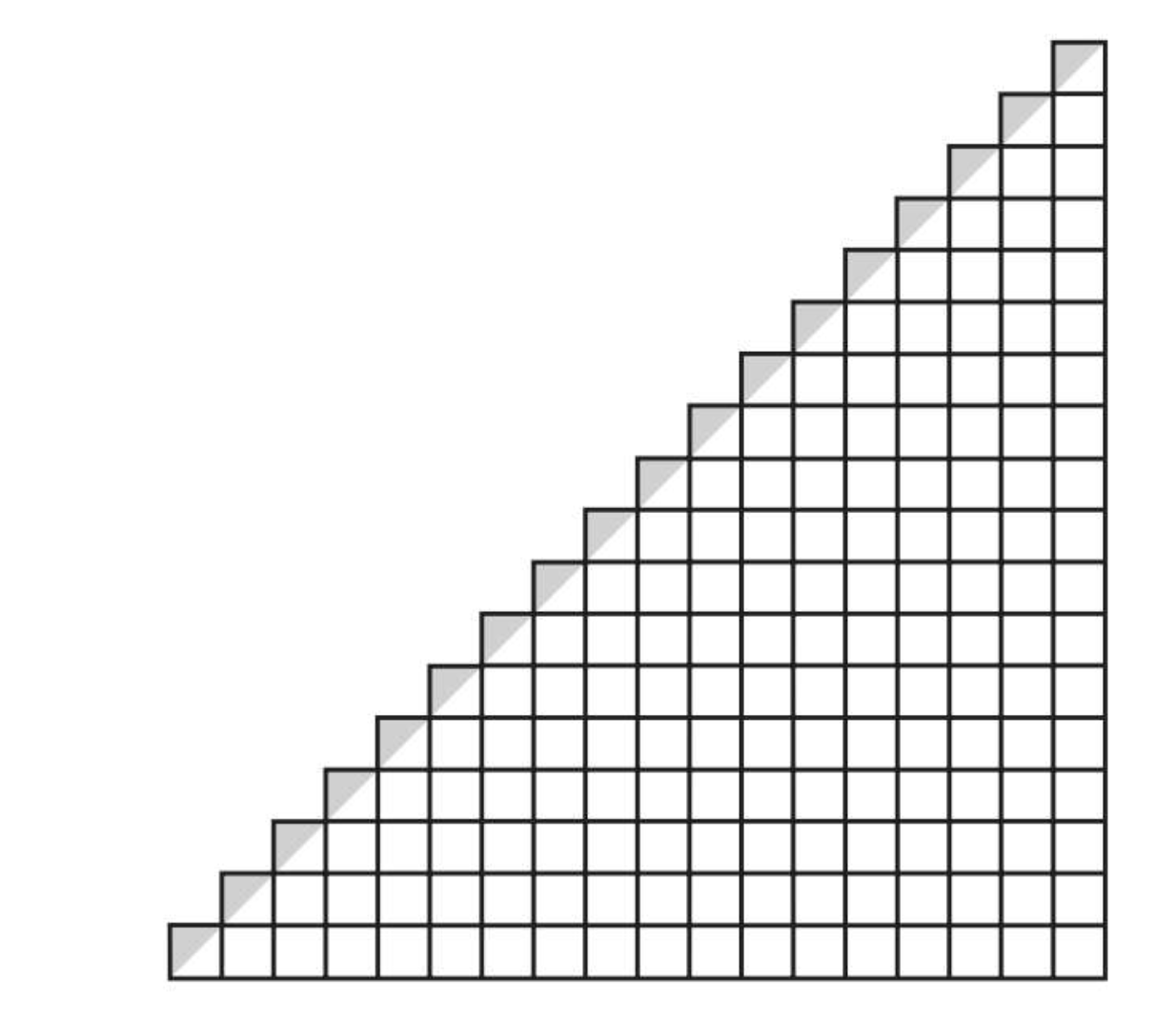
The invisible calculation becomes a triangle you already know how to see. Base 100 × height 100 / 2 = 5,000. Then add the shaded sliver: half of a hundred squares, which is 50. 5,000 + 50 = 5,050. Once that picture is in place, the answer is obvious. No trick to store.
Why math looks so complicated
If intuition is that simple, why did we make math so hard? The demo above is easy. Harder ideas need richer pictures. To the person who already has the picture, it is obvious. To the person who does not, it is a cliff. Words are not enough, so we invent definitions and proofs—just so we can talk.
It is like teaching someone to tie their shoes over the phone. If you already know, your right hand just does it. If they do not, you cannot show them. You can only talk. So you invent a language, and they use that language to rebuild the picture in their own head, and then they can tie the shoe.
That is what learning math actually is. You take the definitions and rebuild the mental image until it becomes intuition.
How you grow the sense
How do you learn math this way? First it is a stance, not a technique, and it is not only for math. I would rather call it perceptual thinking.
Bessis says he was bad at algebra at first. He could not get a picture. Later he stopped trying to see it and started feeling it—in his neck, his spine, his spinal cord. After that the work opened up. His mathematical creativity was not in the same league.
I know that feeling. When I could build a mental map—in math, in physics—I was good. After high school it got harder. Nobody walked me through building a sense of the idea. They handed me tricks to memorize. That is when I lost interest.
Bessis’s method is this: find the place that does not match your intuition. Let logic talk to the picture. Keep going until the part that needed a proof becomes obvious. That is understanding.
We already do this in ordinary life. Complex numbers. Negative one hundred. A few centuries ago, mathematicians thought negative numbers were absurd. Now you glance at a credit-card statement and you get it.
This is the human way to think
People at the far end of the skill—Buddha, Wang Yangming, Steve Jobs—were unusually good at perceptual thinking. Buddha treated the mind as an instrument and watched the body, the feelings, the thoughts, the cravings as they changed. Wang Yangming looked inward for liangzhi, innate knowing. Jobs cared most about taste, and taste is a form of perception.
We live in a time that keeps raising the volume on reason and logic, and turning down feeling and conscience. That is probably the wrong road. Logic and reason belong to machines, to AI. The human way of thinking was never formal logic. It was perception: sensing other people, sensing your own body, sensing your own thoughts and moods. That is how humans are supposed to think. That is also how they get to wisdom.
Notes
[1] David Bessis, Mathematica: A Secret World of Intuition and Curiosity. The Chinese edition is titled 《数学觉醒,学会更清晰的思考》.